Brokenness and the Accidental
This chapter is the hinge of reflection. Many pieces broke unintentionally. Thin porcelain ripples opened along their weakest crests during drying. The MA show piece that layered plates and inserts burst in the kiln where moisture was held in the core. In both cases the event mapped forces already present. When I kept the shards and placed them on sand so that a curve could continue across a gap, the break began to function as information rather than loss. The eye now reads flow through absence as well as through mass. This is consistent with the drawing position of the work. I am not depicting fracture. I am composing a field where seams, distances and edges make the drawing legible in space.
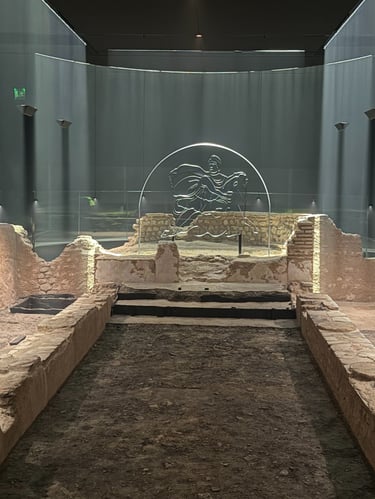
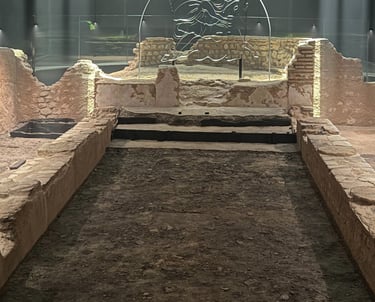
Sarah suggested that I study brokenness and the accidental as a subject. This redirected the work. A fragment is not a waste. It is a record of a moment in time. The studio became an archaeological site where shards sit beside complete tiles so that erosion and clarity can speak to each other. Accepting accidents has a clear art historical precedent. Accounts of Duchamp’s Large Glass describe how later cracks were taken into the work’s meaning rather than repaired away, a decision that allows chance to become structure (Tomkins 1996). Eva Hesse’s early room works also keep material vulnerability active. Change is not cleaned off. It remains readable as part of the work’s language and tempo (Temkin 2002). A visit to the London Mithraeum reinforced this. The artifact wall presents shards and tools as knowledge rather than as loss. A broken pot carries time better than a perfect copy. The point is permission. The practice moves from control toward care. It works with what is present and lets material history remain legible.
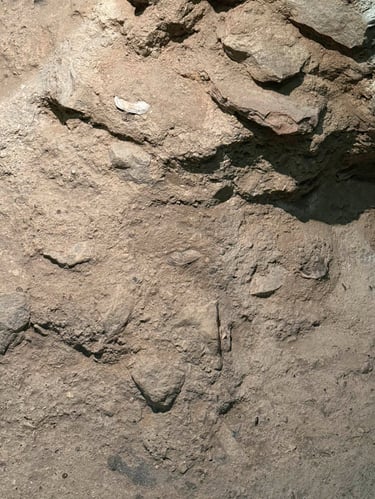
A brief visual analysis makes this concrete. In the exploded kiln piece, several plates cleaved along latent stress paths and left feathered edges and thin lips. Set with even spacing on sand, the group now reads as a low map of forces rather than a collapsed object. The measured gaps operate as drawn seams that hold the fragments together without pretending to restore a single intact form. Under raking light the seam reads first, then the shard, so drawing structures the reading from the ground up. This is the point where accident, repair and field become one language
Next - Between Drawing & Space